
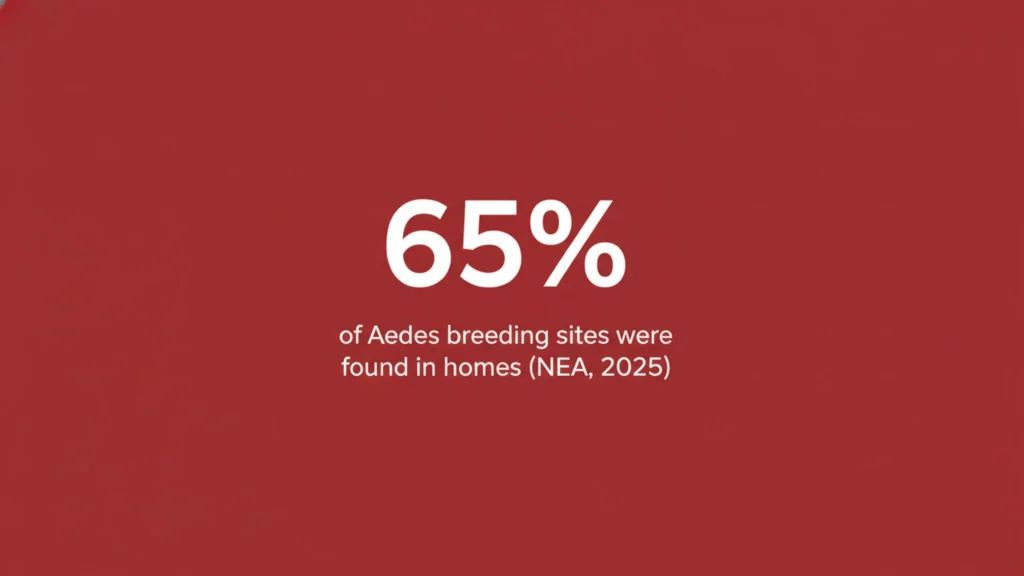
Most people picture mosquito breeding as a drain or a construction site problem. The data says otherwise. In 2025, NEA found that 65% of Aedes mosquito breeding sites in dengue cluster areas were inside homes, not public spaces or worksites.
That means the single most effective mosquito prevention work in Singapore happens in your own kitchen, balcony, and bathroom. This guide gives you the exact NEA checklist, the weekly routine that breaks the breeding cycle, and the fines you avoid by getting it right.
What Is The NEA Mozzie Wipeout And How Often Should You Do It?
Quick Answer: The NEA Mozzie Wipeout is a 5-step routine to remove stagnant water where Aedes mosquitoes breed. Do it at least once a week. The steps spell B-L-O-C-K: Break up hardened soil, Lift and empty flowerpot plates, Overturn pails and wipe their rims, Change water in vases, and Keep roof gutters clear and place BTI insecticide. All it takes is water the size of a 20-cent coin for mosquitoes to breed.
The Aedes mosquito does not need a pond. It prefers clean, stagnant water in small containers around the home. A forgotten pail, a plant pot saucer, or a vase left for a week is enough.
That is why NEA frames prevention around the 5-step Mozzie Wipeout, repeated weekly. The B-L-O-C-K steps are not a one-time spring clean. The Aedes life cycle from egg to adult runs about 7 days in Singapore’s heat, so a weekly reset breaks the cycle before larvae become biting adults.
What most guides skip: dry containers still matter. Aedes eggs survive on dry surfaces for months and hatch the moment water returns. Scrubbing the inner sides of vases and pot plates removes eggs that simple emptying leaves behind.

The Home Mosquito Prevention Checklist (Room By Room)
NEA’s “Checklist For A Mozzie-Free Home” maps directly onto the spots we find breeding during residential inspections. Work through it weekly.
Kitchen and yard
- Overturn pails and watering cans, store them under shelter so they cannot collect water
- Clear any stagnant water in the tray of an air cooler unit
- Change and scrub water in flower vases, wash the roots of any plants in water
Balcony and potted plants
- Remove water from plant pot plates, scrub the plate to remove eggs, or avoid using plates entirely
- Loosen hardened soil in pots so water does not pool on the surface
Bathroom and service areas
- Cover rarely used gully traps, install an anti-mosquito valve, or replace with non-perforated traps
- Add the prescribed amount of sand granular (BTI) insecticide into gully traps and roof gutters, even when dry
Common corridors (HDB)
- Never block scupper drains along the corridor with potted plants or clutter, as blocked drains hold water
A point most homeowners miss: the air-conditioner condensate tray. NEA advises against placing trays beneath or on top of an aircon unit, because they create ideal breeding conditions. If you keep pets or plants, the water bowl and saucer go on the weekly list too.
If you are unsure whether your unit is a recurring source, our HDB pest control checklist walks through what to inspect before calling a professional.

Why Home Breeding Is The Real Problem (The 2025 Numbers)
The case for focusing on the home is in NEA’s own enforcement data. In 2025, NEA carried out about 565,730 mosquito inspections islandwide and uncovered roughly 20,469 breeding habitats.
Of the breeding detected in dengue cluster areas, 65% was in homes, 23% in public areas, 4% at construction sites, and 8% in other premises. The neighbour’s balcony and your own are statistically the bigger risk, not the worksite down the road.
Singapore recorded about 4,036 dengue cases in 2025, the lowest annual total since 2018 and down roughly 70% from 13,651 cases in 2024. By 15 May 2026, fewer than 700 cases had been reported, a 66% drop versus the same period the year before.
Those low numbers are the result of vigilance, not luck. NEA warns that the traditional peak dengue season runs May to October, when warmer temperatures speed up the breeding cycle. A drop in community effort during these months is exactly what lets clusters rebuild. In our experience treating cluster-zone homes, the units that relax their weekly routine in June are the ones calling us in August.
The Fines: What Mosquito Breeding Actually Costs
Mosquito prevention in Singapore is not only a health issue, it carries legal penalties. NEA took more than 9,800 enforcement actions against owners and occupiers in 2025.
For households, a first-time offender faces a $200 composition fine if a single breeding habitat is found, rising to $300 for multiple habitats, or where breeding is detected after a legal notice in a dengue cluster area. Since 2016, this applies to all homes, not only those inside active clusters.
Construction sites face far stiffer penalties: $3,000 for a first offence, with repeat offenders fined $5,000 and liable to be charged in court. In 2025, NEA issued about 810 fines and 37 Stop Work Orders to construction sites, and 73 contractors were charged for repeat offences.
The practical takeaway: a weekly 10-minute wipeout is cheaper than a single fine, and far cheaper than a dengue infection in the household.
Beyond The Checklist: Repellents, Wolbachia, And When To Call A Pro
Removing stagnant water is the foundation. Two further layers help during peak season.
Protect against bites. Aedes mosquitoes are predominantly day-biting. NEA recommends repellents containing DEET, picaridin, or IR3535 as the most effective active ingredients, and sleeping under a net if you nap during the day.
Project Wolbachia is support, not a substitute. NEA is expanding releases of Wolbachia-carrying male Aedes mosquitoes, which mate with females to produce eggs that do not hatch. The project is set to cover more than 800,000 households, about half of all homes in Singapore, by end-2026, and has cut dengue risk by over 70% at release sites. NEA is clear it complements source removal rather than replacing it.
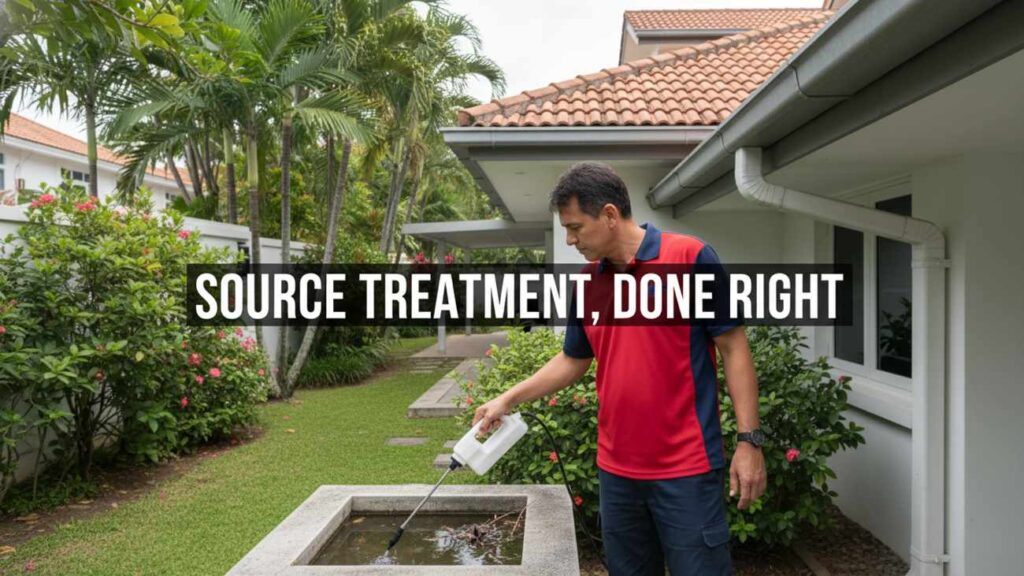
When to call a professional. If you have recurring breeding you cannot trace, a gully trap or roof gutter you cannot safely treat, or you live in an active cluster, an NEA-licensed operator can inspect, apply BTI correctly, and set up misting or residual treatment. See our full pest control services or contact us for a site assessment.
Frequently Asked Questions
How often should I do the Mozzie Wipeout?
At least once a week. The Aedes mosquito develops from egg to adult in about 7 days in Singapore’s climate, so a weekly routine breaks the cycle before larvae mature. During peak season (May to October) or if you live in a cluster, twice a week is safer.
What is the fine for mosquito breeding in a home in Singapore?
A first-time residential offender faces a $200 composition fine for a single breeding habitat, or $300 if multiple habitats are found, or if breeding is detected after a legal notice in a cluster area. Construction sites face $3,000 for a first offence and $5,000 for repeat offences.
Where do mosquitoes most commonly breed in a Singapore home?
Flowerpot plates and saucers, vases, pails and watering cans, hardened soil in pots, air cooler trays, aircon condensate trays, gully traps, and roof gutters. NEA found 65% of Aedes breeding in cluster areas was inside homes in 2025.
What is BTI and where do I use it?
BTI (Bacillus thuringiensis israelensis) is a biological larvicide that kills mosquito larvae but is safe for humans and pets at prescribed doses. Apply it in roof gutters, gully traps, and vases, including ones that are currently dry, since Aedes eggs survive on dry surfaces.
Does Project Wolbachia mean I can stop doing the wipeout?
No. NEA states Project Wolbachia complements source removal, it does not replace it. Removing stagnant water remains the most direct and effective way to prevent breeding, even in Wolbachia release areas.
Make The Weekly Wipeout A Habit
Three things matter most for mosquito prevention in Singapore: do the 5-step Mozzie Wipeout weekly, treat the spots most homeowners forget (aircon trays, gully traps, dry containers), and keep it up through the May to October peak.
The home is where 65% of breeding happens, which means it is also where prevention works best. If breeding keeps coming back despite a consistent routine, that is the signal to bring in an NEA-licensed inspection. Get a free quote from StopPest or read our FAQ to see how a professional treatment fits around your weekly checklist.

StopPest | NEA-licensed pest control | Singapore
SEO METADATA
Meta title: Mosquito Prevention Singapore: The NEA Home Checklist (55 chars)
Meta description: Mosquito prevention in Singapore starts at home, where NEA found 65% of Aedes breeding. Get the 5-step Mozzie Wipeout checklist, fines, and when to call a pro. (157 chars)
Focus keyword: mosquito prevention singapore
Secondary keywords:
- NEA mozzie wipeout
- aedes mosquito breeding home singapore
- dengue prevention singapore 2026
- mosquito breeding fine singapore
- BTI insecticide singapore
- 5-step mozzie wipeout BLOCK
URL slug: /blog/mosquito-prevention-singapore-nea-checklist
Word count (approx): 1,500 (body, excluding metadata)
Internal links (real, verified live):
- https://stoppest.com.sg/services/ — anchor “pest control services”
- https://stoppest.com.sg/contact-us/ — anchor “contact us” / “Get a free quote from StopPest”
- https://stoppest.com.sg/faq/ — anchor “FAQ”
- https://stoppest.com.sg/hdb-pest-control-checklist-what-to-do-before-calling-a-professional/ — anchor “HDB pest control checklist” (1 blog link)
External authority link: https://www.nea.gov.sg/dengue-zika/stop-dengue-now — anchor “5-step Mozzie Wipeout” (NEA, in body)
Images: 6 image blocks (1 feature + 5 body; 2 infographic/stat-card per brand rule)
Information Gain signals used:
- 65% of Aedes breeding in dengue cluster areas found in homes; 23% public, 4% construction, 8% other (NEA 2025)
- 2025 enforcement: 565,730 inspections, 20,469 breeding habitats, 9,800+ actions; construction 810 fines, 37 SWOs, 73 charged
- Exact fine schedule: home $200 single / $300 multiple; construction $3,000 first / $5,000 repeat
- Case totals: 4,036 in 2025 (lowest since 2018) vs 13,651 in 2024; <700 by 15 May 2026 (-66%)
- Project Wolbachia to cover ~800,000 households (50%) by end-2026, dengue risk down 70%+ at sites
PAA questions addressed:
- How often should I do the Mozzie Wipeout?
- What is the fine for mosquito breeding in a home in Singapore?
- Where do mosquitoes most commonly breed in a Singapore home?
- What is BTI and where do I use it?
- Does Project Wolbachia mean I can stop doing the wipeout?
Sources (fact-check): NEA Stop Dengue Now + Prevent Aedes Breeding pages; NEA media release 16 May 2026; The Straits Times 16 May 2026; CNA 15-16 May 2026.
Status: Draft v1 — text + image prompts ready. NEXT: /blog-images to generate + embed images, then publish as DRAFT (replaces failed ant-infestation duplicate).