
You sprayed the kitchen. You bought two boxes of supermarket gel. Three weeks later the roaches are back, and now they are in the bathroom too.
That cycle is the most common story we hear in Jurong West and Clementi. It is not bad luck. German cockroaches breed faster than DIY products can kill them, and most home sprays never reach the nest.
This guide covers what professional cockroach control in Singapore actually costs, what a treatment looks like step by step, and why the species in your kitchen decides which method works. Prices are real 2026 SG rates, not overseas guesses.
How much does cockroach control cost in Singapore?
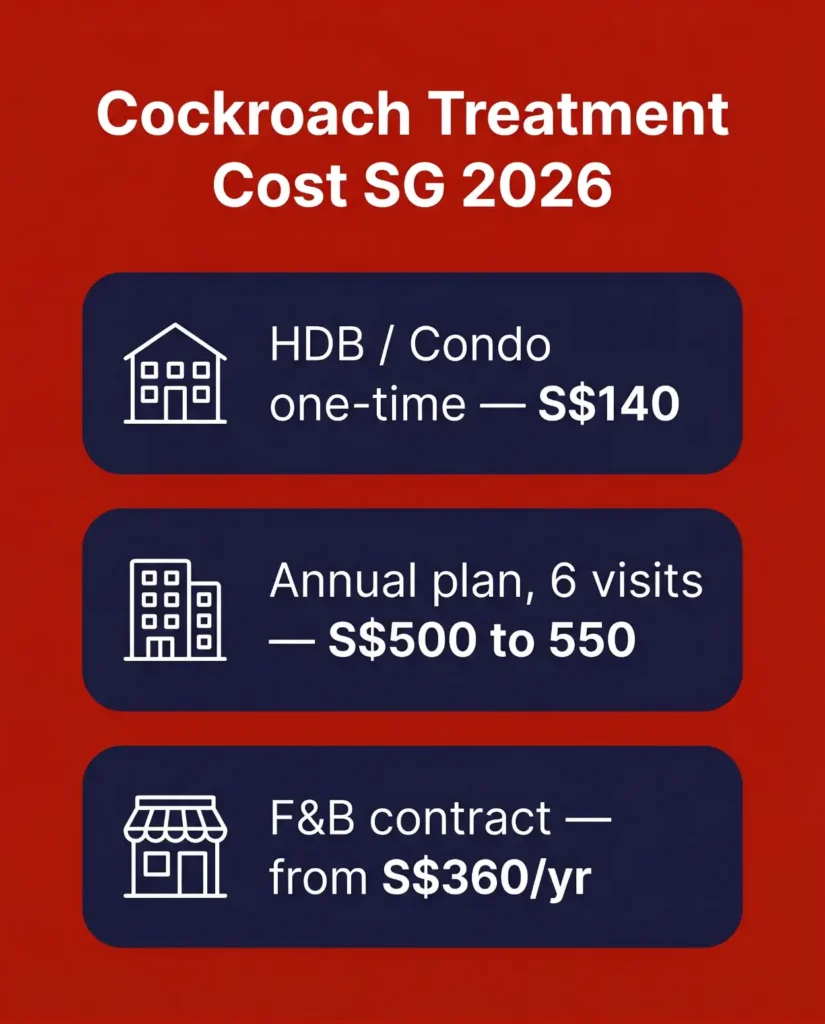
Quick Answer: A one-time cockroach treatment for an HDB flat or condo unit in Singapore runs about SGD 120 to 150, with most NEA-licensed firms charging a flat SGD 140. A bi-monthly annual plan (6 visits) costs around SGD 500 to 550 a year, roughly SGD 85 to 90 per visit. F&B outlets pay more because NEA-graded kitchens need recurring contracts.
Pricing tracks property type and how deep the infestation has gone.
For a standard HDB flat, expect SGD 140 for a single visit covering inspection and treatment. A condo unit sits in the same band. Landed homes cost more, often SGD 150 to 230 one-time, because there is more floor area and more entry points to seal.
Heavy German cockroach infestations rarely clear in one visit. Some firms sell a 4-week intensive block (weekly visits) for around SGD 450 when a kitchen is overrun.
F&B is a different game. A small café might start at SGD 200 to 400 for an initial knock-down, then move to a monthly or bi-monthly contract. Larger restaurants bundling roaches, rats, and flies often pay several hundred to over SGD 1,000 a year. We break the residential numbers down further in our transparent pest control pricing guide.
What most quotes hide: GST and the follow-up visit. We quote the all-in number up front, including the second visit if your case needs it.
What does a professional cockroach treatment include?
A real treatment is not one person spraying along the skirting and leaving. It follows a method, because cockroaches hide where sprays cannot go.
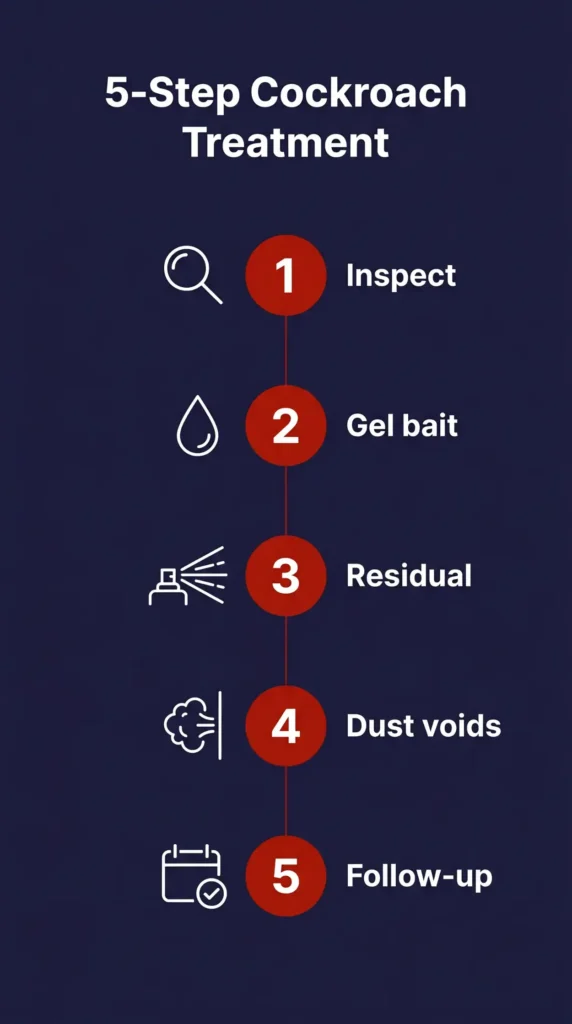
Here is the 5-step process we run on a typical HDB or condo job.
First, inspection. The technician checks every high-risk zone: kitchen cabinet hinges, behind the fridge, under the sink, the rubbish chute access, and bathroom floor traps. This is where we confirm the species, which changes the plan.
Second, gel baiting. Small dots of professional gel go into cracks and harbourage points. The roach eats it, returns to the nest, and the active ingredient spreads through the colony, including egg cases the spray would never touch.
Third, residual treatment. A water-based residual is applied along skirting boards, drain edges, and entry points. It stays active for 4 to 8 weeks and kills roaches crossing the surface later.
Fourth, crevice dusting. Insecticidal dust is puffed into deep wall voids where liquids cannot reach, which handles hidden nests.
Fifth, the follow-up. Mild to moderate cases clear in 1 to 2 visits. Severe German cockroach nesting usually needs 2 to 3 visits spaced 2 to 4 weeks apart, timed to catch nymphs as eggs hatch.
A standard visit takes 45 to 60 minutes for a flat. Seeing a few roaches in the first 48 hours is normal. It means the bait is working, not failing.
Why your supermarket spray keeps failing
The species hiding in your kitchen decides whether DIY has any chance. In most SG homes it is the German cockroach, and that is the one that beats off-the-shelf products.
Two things work against you.
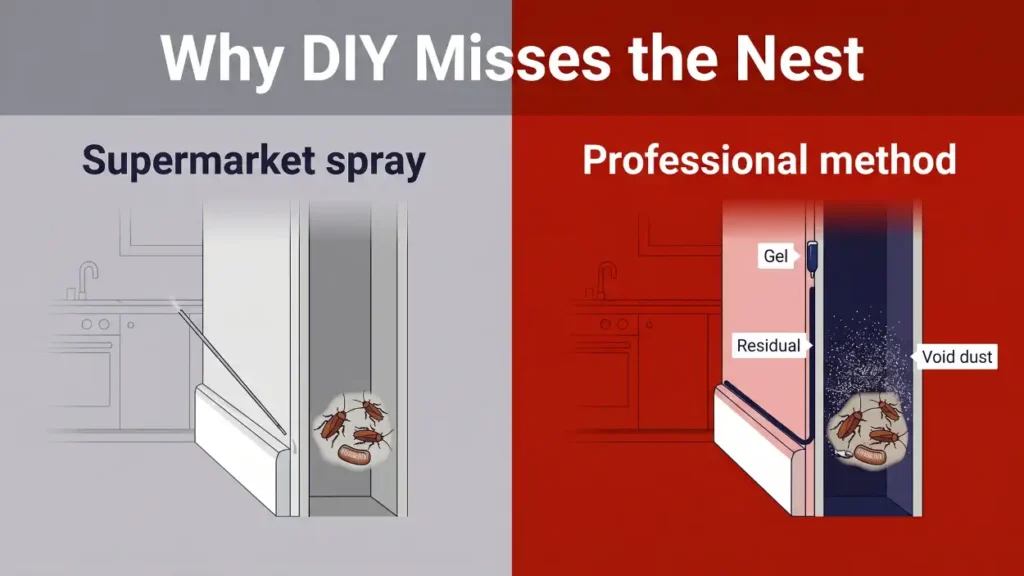
The first is bait aversion. German cockroach populations that have eaten sugar-based baits for years have evolved to avoid glucose. They walk past the supermarket gel and feed on grease and crumbs instead. A few die, the colony survives, and you think the product is a dud.
The second is pyrethroid resistance. Most supermarket aerosols are pyrethroids. After years of low-dose exposure, many roaches carry detox enzymes and knockdown-resistance mutations. The visible ones drop, but nymphs deep in the wall void shrug it off and recover.
There is also a building problem unique to Singapore. HDB blocks share vertical risers and bin chutes, so even a clean unit gets reinfested from a neighbour’s flat. One-unit spraying cannot win that fight.
We cover how to tell the two species apart in our guide on American vs German cockroaches and why DIY baits fail. Get the ID wrong and you treat the wrong harbourage.
Professionals beat resistance by rotating bait formulations, using non-repellent residuals, and adding insect growth regulators that break the breeding cycle. None of that sits on a supermarket shelf.
Cockroach rules for HDB homes and F&B kitchens
For homes, the win is preparation plus timing. Clear the cabinet you want treated, fix dripping taps, and seal the gaps around pipe entries and drain covers after treatment. Our HDB pest control checklist lists what to do before the technician arrives.
For F&B, the bar is set by NEA. Licensed food premises must stay free of cockroaches, rodents, and flies, and chemical treatment must be done by an NEA-licensed operator using registered pesticides. The requirement sits under the Environmental Public Health (Food Hygiene) Regulations, which you can read on the National Environment Agency site.
Repeated cockroach sightings in a kitchen during inspection can cost demerit points and drag down a hygiene grade. That is why most graded outlets keep a monthly or bi-monthly contract with inspection records on file, not a one-off call when things get bad.
In our experience, the F&B outlets that pass cleanly are the ones treating bin centres and gully traps on a schedule, not just the prep line.
Frequently asked questions
How long does it take to get rid of cockroaches?
A noticeable drop in sightings starts within the first week. Gel bait keeps spreading through the colony over the following two weeks. Mild cases clear in one visit; heavy German cockroach nests need 2 to 3 visits over 3 to 4 weeks to catch hatching nymphs.
Why do I see more cockroaches right after treatment?
This is normal in the first 24 to 48 hours. Residual surfaces flush roaches out of harbourages, and baited insects move around before they die. More activity in that window usually means the treatment is working.
Is cockroach treatment safe for kids and pets?
Yes, when done by an NEA-licensed firm using targeted baits and gels placed inside cracks and cabinets rather than open spraying. Keep children and pets out of treated rooms until surfaces dry, usually a couple of hours.
Do I need a recurring plan or a one-time visit?
A one-time visit suits a fresh, light problem. If you live in an older block, share walls with an infested unit, or run an F&B kitchen, a bi-monthly plan at around SGD 500 to 550 a year is the cheaper path over time.
Get the right method for your kitchen
Cockroach control comes down to three things: correct species ID, treatment that reaches the nest, and a follow-up timed to the hatching cycle. Supermarket sprays miss all three.
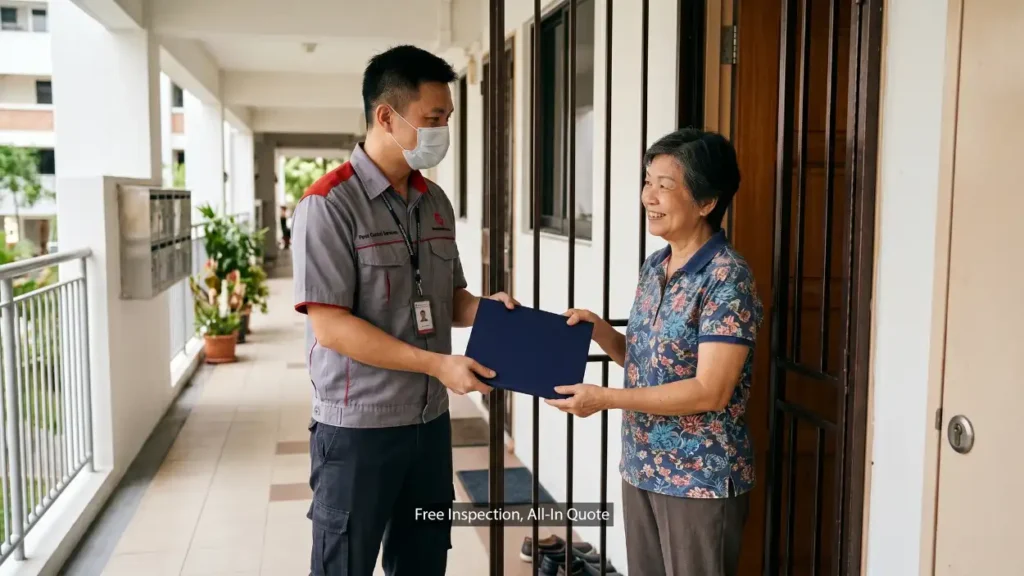
If the roaches keep coming back, the spraying was never the problem. The nest was. Book a free inspection through our contact page and we will quote the all-in number, GST included, before any work starts.
StopPest | Cockroach Control | Singapore