
If you own a landed house in Jurong or Bukit Timah and someone tells you “we will do corrective soil treatment”, it can sound like expensive magic.
This guide explains what actually happens under your floor, how soil treatment differs from simple baiting at the skirting, and what a typical job on a Singapore landed home looks like.
How termite soil treatment protects a landed house
Corrective soil treatment creates a continuous chemical barrier in the soil under and around your house. Technicians drill or rod through concrete and inject termiticide so termites are killed or pick up the chemical before they reach beams, parquet and built ins. Bait at skirting level only treats activity. Soil treatment protects the structure.

Bait at skirting level versus full soil treatment around the house
Many owners only hear “bait” or “soil treatment” from different pest companies. Both have a place, but they work in different ways.
What skirting level baiting does
Indoor termite baiting deals with current activity at your skirting, door frames or built ins.
Typical features:
- Small bait stations or bait boxes placed at visible termite trails. Termites feed on bait and share it with the colony. General background on termite behaviour is well covered on Wikipedia.
- Minimal drilling and noise. Good for condos and HDB units where you cannot hack the floor.
Limitations for landed homes:
- Bait usually sits at or above floor level, while subterranean termites move in soil and hidden mud tubes. Local guides, show how often damage starts below what you can see.
- It may remove a colony but does not always give long term soil protection beneath your foundation. Technical manuals from agricultural extensions, for example the University of Arkansas Extension termiticide guide, treat soil barriers as the core long term protection.
What soil treatment around the house does
Corrective soil treatment or post construction soil treatment is different. The goal is to create a treated zone in the soil around and under the structure.
You will often see soil treatment described as:
- Technicians drilling holes through concrete slabs or tiles at fixed intervals along external and sometimes internal walls, then injecting termiticide to reach the soil below.
- Rodding or trenching bare soil and treating the ground directly.
- The chemical spreading through the soil to form a barrier that termites contact or cross on their way to your house.
For a landed house, that barrier is what protects:
- Ground beams and foundation
- Timber joists and subfloor
- Parquet floors, built in wardrobes and kitchen carpentry
When a StopPest team might use both
At StopPest, technicians working on landed homes often use both approaches. Soil treatment protects the structure. Targeted bait or dust removes remaining activity in skirting or built ins.
This mix is very different from a quick “spot spray” that only chases visible termites and leaves the soil untouched.
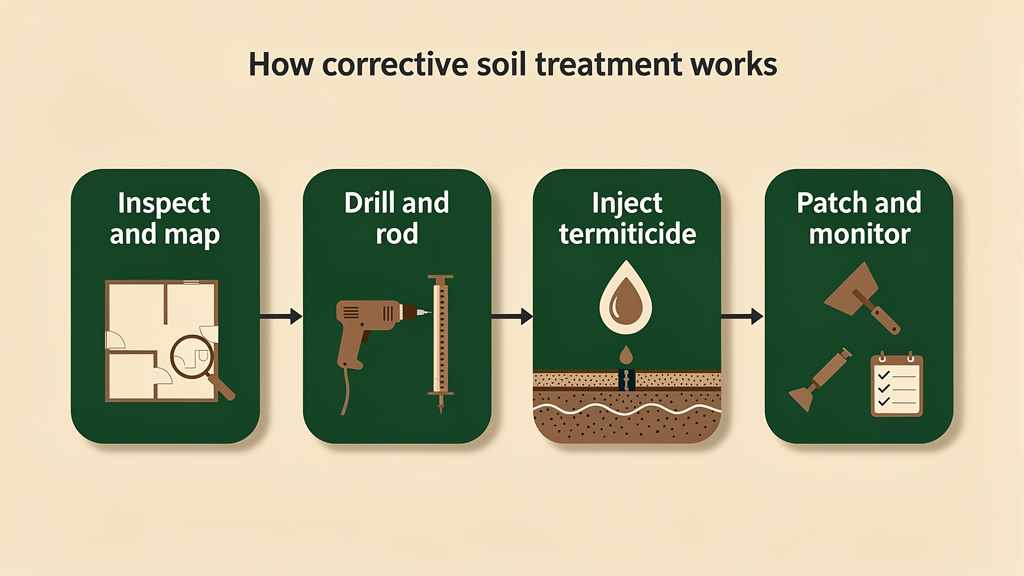
How drilling, rodding and chemical barriers really work
If you have marble floors in Bukit Timah or outdoor decking in Jurong, the part that worries you is the drilling. Here is what actually happens during a standard corrective soil treatment in Singapore.
1. Inspection and mapping
Before any drilling starts, a licensed pest control operator inspects the property.
They identify:
- Termite species and activity points.
- Where the concrete slab sits relative to soil.
- Sensitive areas such as ponds, drains and neighbour boundaries. Guides from local operators like Killem Pest show how much time goes into this step.
The National Environment Agency (NEA) requires that soil treatment is done with approved termiticides, under good visibility, on soil that is not waterlogged and by trained operators from registered pest control companies.
2. Drilling through the slab
Along concrete or tiled areas next to walls, technicians drill small holes through the slab to reach soil under the house or along the foundation.
Common practice in Singapore and the region typically uses:
- Hole diameter around 16 to 18 mm.
- Spacing roughly 30 to 45 cm apart in a straight line along the wall.
- Holes placed close to the wall so the injected chemical reaches soil next to the footings.
Indoor drilling usually happens along skirting lines, under built in cupboards or behind loose furniture to keep things tidy.
3. Rodding and trenching in soil areas
In garden beds, planter boxes or exposed soil, drilling is not needed.
Instead the team:
- Digs a shallow trench along the foundation, or
- Uses a hollow rod to inject termiticide straight into the soil at intervals.
The goal is the same. Build a continuous treated band of soil that termites must cross.
Technical references, such as the University of Arkansas Extension AG1154 manual, describe this same principle.
4. Injecting the termiticide
Liquid termiticide is then injected through each drilled hole or rod point at a set flow rate and volume per metre of wall. Industry guides often refer to about 5 litres of solution per linear metre, adjusted for soil depth and product label.
Two common ways this protects your house:
- Contact effect. Termites that hit the treated zone die or are affected. Overviews like the Rentokil Singapore page describe this clearly.
- Transfer effect. With modern non repellent termiticides, termites pick up the chemical and spread it through the colony. Chemical suppliers, for example BASF’s liquid termiticides page, explain how this works at product level.
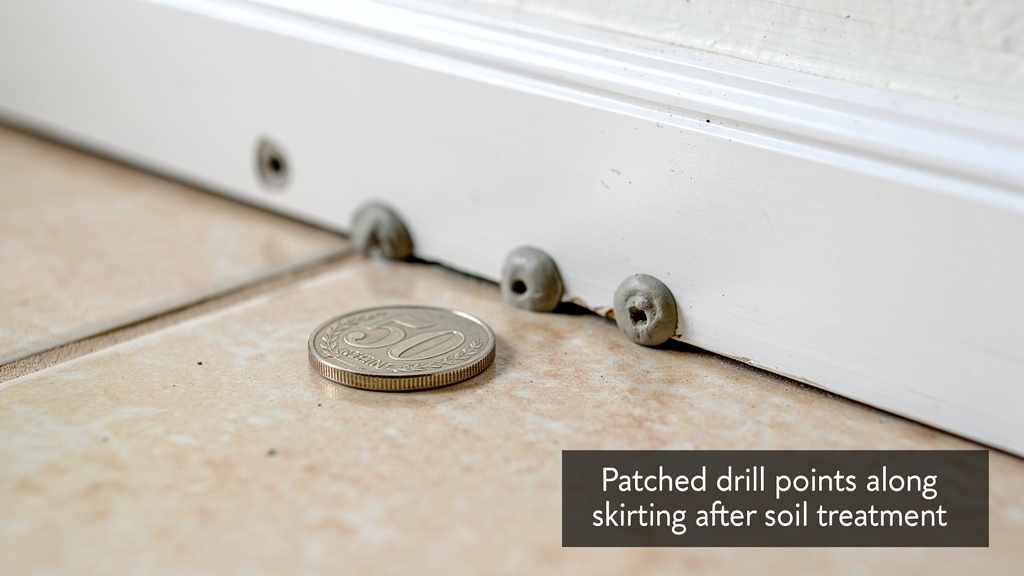
5. Patching and clean up
Once injection is done, technicians seal the drilled holes with cement or matching grout and clean the work area. Scandinavian group [Anticimex Singapore] shows examples of finished patching and post treatment cleanup.
A good crew will:
- Avoid the middle of decorative tiles wherever possible.
- Warn you about short periods where you should avoid freshly treated soil, in line with the termiticide label and NEA guidance on safe use.
The result is largely invisible once patched, but the barrier remains in the soil for years depending on product and site conditions.
What a typical landed job in Jurong or Bukit Timah looks like
Every house is different, but most Singapore landed homes follow similar patterns. Here is a realistic example so you know what you are paying for.
Example house
- Two storey semi detached house in Jurong
- Built on a concrete slab with small garden at front and side
- Approximate external perimeter in contact with soil and slab: 40 metres
Active subterranean termites found at:
- Skirting in living room
- Built in wardrobe at second floor
The house had pre construction treatment many years ago, but the owner no longer has the warranty documents, which is common for older properties. Homeowner forums like RenoTalk are full of similar stories.
Number of holes and treated points
For this layout, a typical corrective soil treatment plan might include:
- Drill holes along internal skirting where slab meets walls in the living and dining area.
- Drill holes along external slab edges around the perimeter.
- Rod treatment along soil borders in the side garden.
Using common drilling spacing of about 30 to 45 cm between holes, a 40 metre combined slab perimeter gives around 90 to 130 drill points, plus rodding spots in soil areas.
A proper quote from a company like StopPest should show:
- Total estimated length treated in metres.
- Estimated number of drilling points.
- Whether internal and external perimeters are both included.
Visit schedule
A simple but realistic schedule for a Jurong or Bukit Timah landed house might look like:
- Visit 1: Inspection and proposal
- Moisture meter and tapping to locate hidden activity.
- Check boundary conditions, drains and neighbour proximity.
- Explain bait plus soil options and agree scope. This is the pattern used in StopPest’s termite control in Singapore workflows.
- Visit 2: Corrective soil treatment day
- Drill, rod and inject termiticide around the agreed perimeter.
- Treat any soil trenches and backfill with treated soil.
- Patch holes and tidy site, following good practice similar to the approach shown by Rentokil in their Singapore termite treatment explanation.
- Visit 3: Follow up inspection
- Usually 4 to 6 weeks later. Check for fresh mud tubes or activity at old spots.
- Top up dust or skirting treatments if small pockets of activity remain. Local operators such as [Killem Pest] describe similar follow up visits.
- Ongoing checks
- Annual or biannual inspections to confirm the structure is still clear, sometimes included as part of a multi year program. Long term soil treatment warranties of around five years or more are common for landed properties.
This is why quotes for landed homes look higher than a quick skirting bait job. You are paying for drilling time, termiticide volume per metre and follow up labour, not just a few plastic stations.

How soil treatment protects beams, parquet and built ins
From a homeowner view, termites appear at:
- Parquet floors that sound hollow
- Skirting that flakes when you tap it
- Built in wardrobes with mud trails
Local explainers, for example Pestwerkz’s guide, show exactly how these symptoms often trace back to hidden soil access points.
The actual damage chain usually moves like this:
- Termites travel from soil up foundation and ground beams.
- They enter timber touching the slab, such as bottom of door frames or wardrobe bases.
- They spread into parquet, beams and hidden built ins.
By treating the soil along the foundation and slab edges, corrective soil treatment aims to break that chain near the source, not only where you see damage.
Spot spraying or only replacing damaged wood may tidy the appearance but leaves the underground colony free to find a new route.
Where StopPest fits in for landed homes
StopPest already focuses on structured termite control that starts with inspection and specific tools like moisture meters and skirting level checks for detection.
For landed homes with soil contact, a complete plan usually includes:
- Detection
Moisture and sounding checks to find hidden galleries and high risk zones. - Decision on method
For HDB and condos, baiting and skirting level work may be enough. For Jurong, Bukit Timah or Seletar landed houses with gardens and car porches, soil treatment around the structure usually sits at the centre, with bait used for cleanup where needed. Anticimex and other international operators describe a similar split between soil barriers and baiting. - Execution
Corrective soil treatment carried out by NEA certified technicians, with drilling, rodding and termiticide selection documented in the job report. The licensing and regulatory expectations for pest companies are outlined by resources such as Termite Specialist Singapore’s summary of NEA guidelines. - Monitoring
Follow up inspections and skirting checks that match the warranty period, along the same lines as the long term programs used by Anticimex and other global brands, but with a local StopPest crew who know Singapore housing types well.
Internal links you can add inside this article on StopPest.com.sg:
- Link “termite control in Singapore” to your main Termite Control service page.
- Link “pest control for landed property” to a relevant service or case study page when you build it.
Quick FAQ for landed homeowners
Is soil treatment always better than baiting
For landed homes where technicians can reach the full perimeter, soil treatment is usually the main long term protection because it blocks termite entry at soil level. Bait adds value where drilling is difficult or as an extra hit on active colonies. Government and university sources treat both as valid tools, with soil barriers as the base.
Will drilling ruin my tiles
Drilling for corrective treatment uses small holes placed close to grout lines and walls. Holes are then patched with cement or tile coloured filler. On most marble or ceramic floors the work is visible only on close inspection after patching, though you should expect some cosmetic marks along skirtings. Local guides, for example from Innovative Pest and others, show realistic photos of this finish.
How long does termite soil treatment last
With correct application, reputable termiticides used in Singapore are marketed to provide several years of protection in the soil, often with warranties of about five years or more depending on the product and company. Regular inspections remain important because soil conditions and construction details differ from house to house. Extension resources and product labels all stress this point.
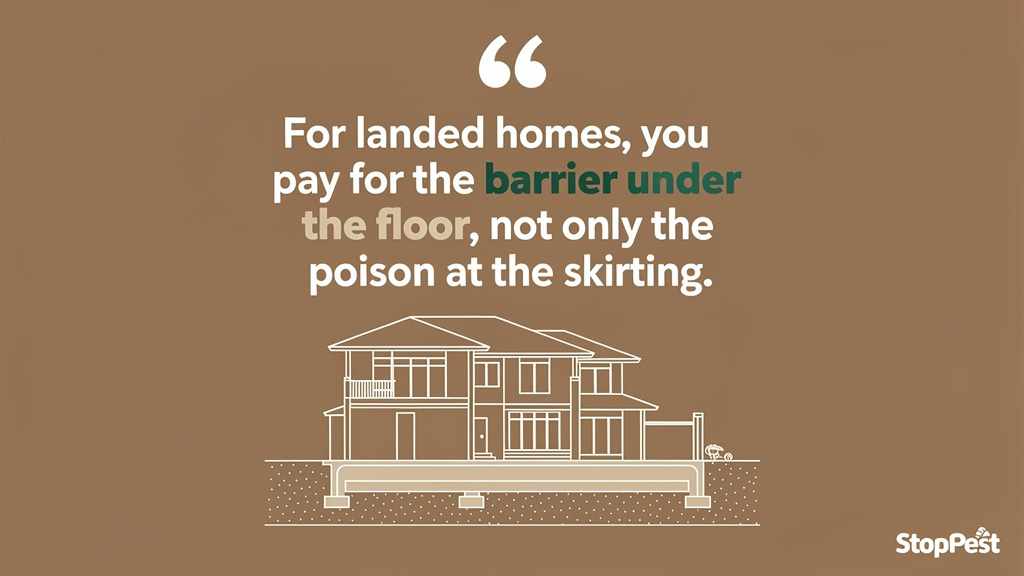
You are not paying only for “poison at the skirting”. For a landed home, you are paying for the invisible barrier under your floor that stops termites before they ever reach your timber.